
The front end of a Land Rover Defender, the profile of a Toyota Land Cruiser, the build of a Range Rover, and yet… this is indeed a Chinese SUV from iCaur, a young brand barely known outside of Asia. The model is called the V27 and could well become a textbook case: 449 hp, 745 miles of claimed range, and a price under $33,500. Behind this familiar silhouette lies a technological powerhouse that’s shaking up the family SUV segment.
Contrary to what its design might suggest, the V27 is not a traditional gas-powered 4×4. It’s built on an EREV (Extended Range Electric Vehicle) powertrain where the gas engine never drives the wheels, but serves solely as a generator to recharge the battery. With a relatively modest capacity of 34.3 kWh, the system would still deliver nearly 745 miles of combined range, a spectacular figure for a vehicle that’s over 16 feet long.
And perhaps most surprising is its pricing strategy. In China, the iCaur V27 should be marketed between $26,800 and $33,550 depending on trim levels – that’s the price of a Jeep Compass 4×4. An unthinkable offer in the US today, but one that reveals the growing gap between Chinese and Western industrial logic. So is the V27 just an Asian oddity, or a glimpse into the very near future for family SUVs on this side of the world?
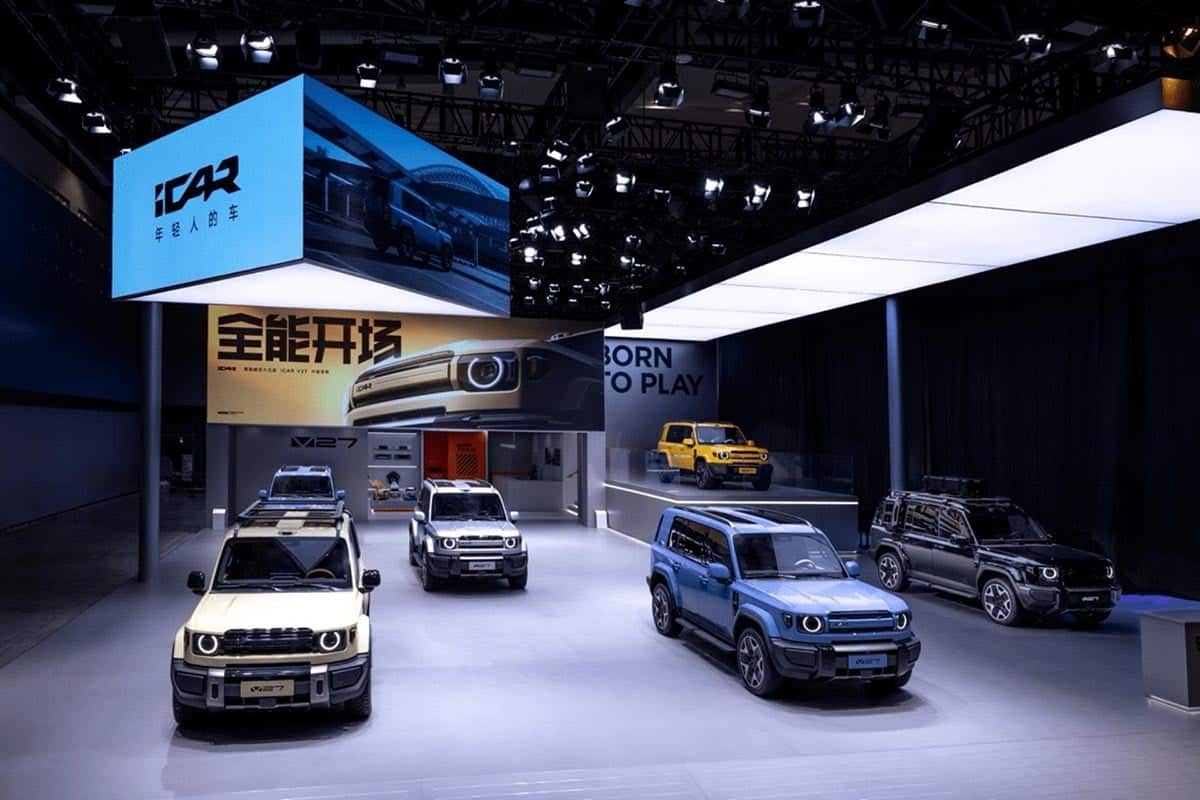
An XXL SUV with familiar looks at a mind-bending price
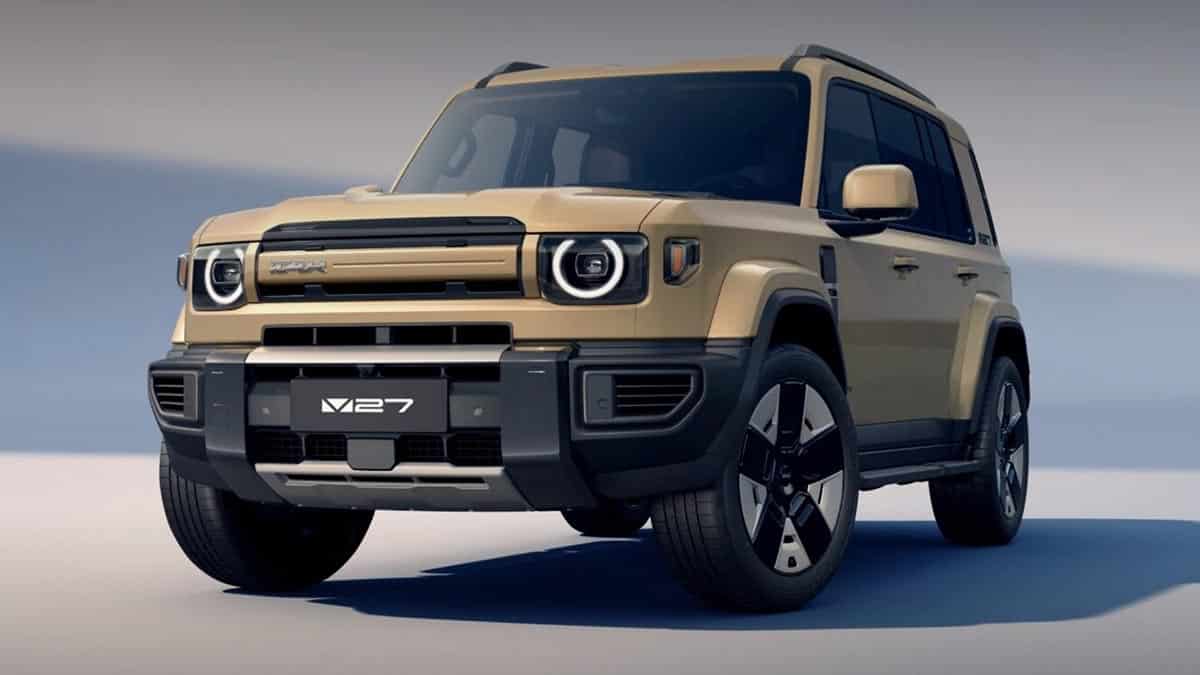
It’s hard not to make the connection. From the front, the iCaur V27 clearly channels the Land Rover Defender, while its profile distinctly evokes the Toyota Land Cruiser 250. It’s a deliberate strategy by the young Chinese brand, drawing inspiration from 4×4 icons to appeal to a global audience seeking robust and reassuring style. At 16.4 feet long, 6.5 feet wide, and 6.2 feet tall, the V27 plays in the big leagues of family SUVs, alongside the Range Rover.
But beyond its muscular lines, the V27 impresses most with what it promises: a powerful powertrain, exceptional range, and above all, a price that defies all competition. It’s also the largest and most ambitious model ever produced by iCaur, already known in China for its more compact SUVs (03 and V23). The V27 therefore represents an aggressive move upmarket, but without abandoning the logic of technological low-cost production.
The flattering aesthetics aren’t just window dressing: they serve a clear positioning. That of a vehicle that aims to rival established references, but at prices up to three times lower. Enough to attract attention, even in the US, where traditional manufacturers are starting to feel the breath of Chinese brands on their necks.
A very particular hybrid powertrain: the EREV
The iCaur V27 is not a traditional gas SUV, nor even a plug-in hybrid in the American sense. It’s an EREV — Extended Range Electric Vehicle — a technical architecture still rare in the States. Here, the wheels are driven solely by an electric motor, while the gas engine onboard serves only as an energy generator to recharge the battery when it’s depleted.
This technical choice allows for combining electric driving, plug-in charging, and long-distance range. The V27 even offers two versions, with one or two electric motors, for a maximum claimed power of 449 horsepower. A remarkable figure for a vehicle of this size, especially at this price point. The battery, at 34.3 kWh, may seem modest at first glance, but combined with the gas generator, it would achieve up to 745 miles of total range, according to official data.
Such a configuration makes the V27 particularly interesting for long trips, without range anxiety. But it also raises questions about the actual consumption of the gas engine, its environmental impact, and especially about the possibility of certification in the US, where regulations governing this type of vehicle remain unclear.
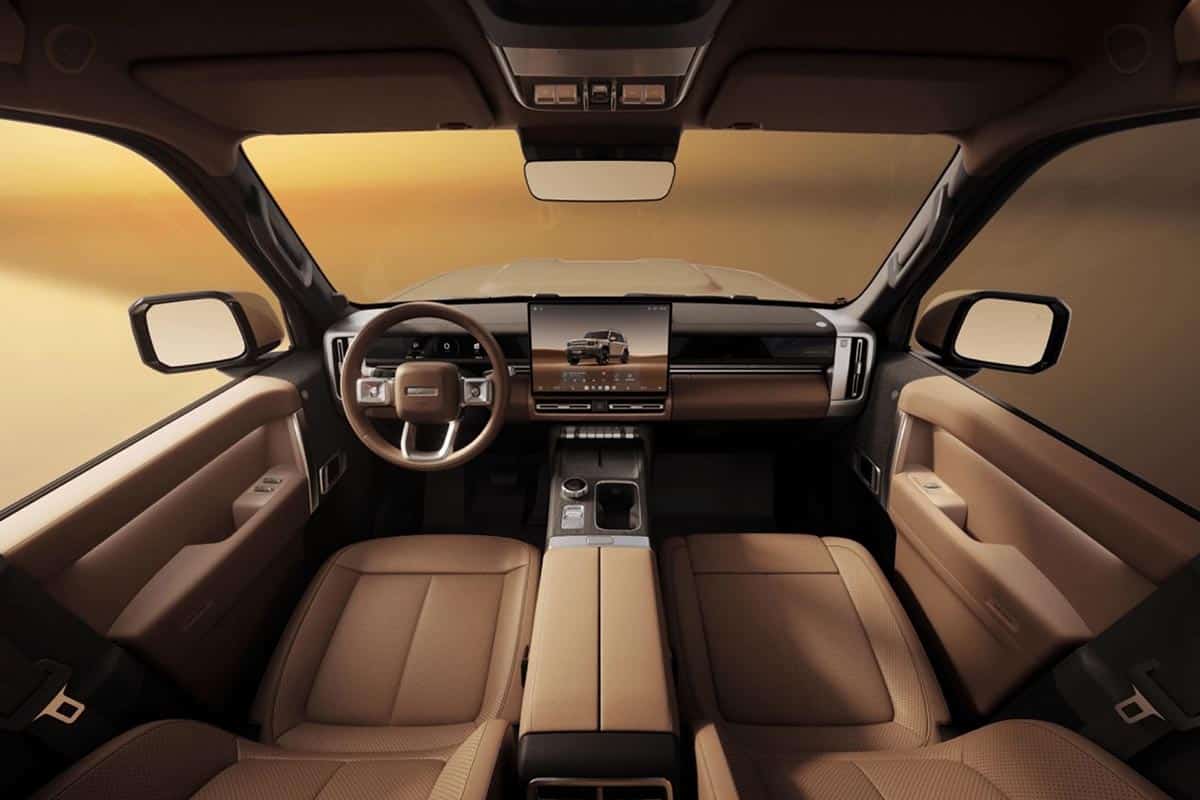
A tech-forward but practical interior
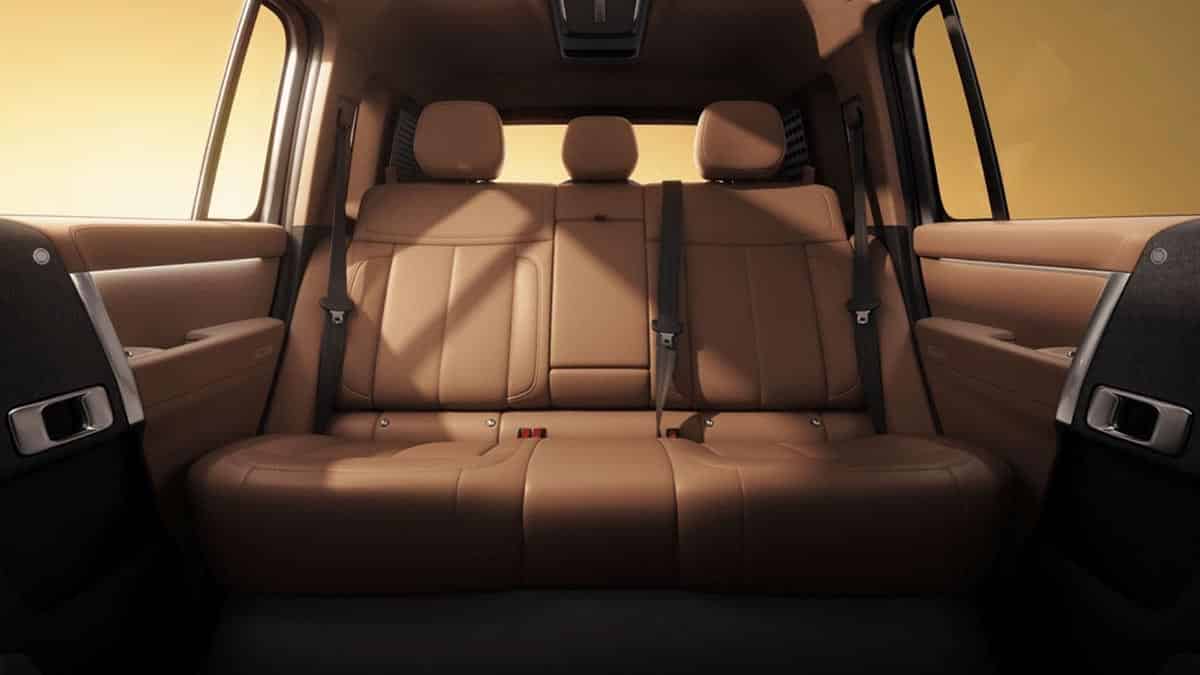
If the V27’s exterior plays up the nod to luxury 4x4s, the cabin remains more understated. The atmosphere is functional, with straight lines, simple materials, and — rare today — the presence of physical buttons for certain controls. A choice appreciated by drivers allergic to all-touch interfaces, reflecting a commitment to ergonomic pragmatism.
The centerpiece remains the massive central screen, running on a Qualcomm Snapdragon 8295 chip, one of the most powerful processors in the automotive sector. This embedded system enables enhanced responsiveness, better management of driver assistance features, and advanced software updates. Proof that Chinese low-cost production doesn’t neglect high-end connectivity.
Another striking element: the presence of a Lidar sensor, dedicated to autonomous driving functions. While autonomy levels aren’t yet specified, this equipment suggests the V27 could feature advanced semi-autonomous functions, a rarity at this price point.
Unbeatable pricing… but at what cost for America?
Between $26,800 and $33,550 according to initial estimates in China: that’s what an iCaur V27 would cost, depending on the chosen trim. For comparison, a Jeep Compass 4×4 starts in the US around $28,600, for a much smaller footprint and far less powerful powertrain. At this level of technology, size, and performance, the V27 becomes almost surreal… or at least unrealistic in America without a complete overhaul of industrial logic.
This price isn’t explained by magic, but by massive subsidies, ultra-optimized local production, and economies of scale inaccessible to American brands. As long as this model stays confined to China, it remains an aggressive technological showcase, but harmless. However, with the massive arrival of Chinese manufacturers like BYD, Leapmotor, MG, or Nio in global markets, it’s not inconceivable that iCaur or a competitor could scale the same concept.
One thing is certain: Western manufacturers can no longer ignore these propositions. The iCaur V27 embodies a paradigm shift: one where a 16-foot SUV, ultra-technological, high-performance, and electrified can cost less than a mainstream gas American model. The question is no longer if these vehicles will arrive… but when.

